Kinredgarten Saulės Gojus
Sometimes a child’s emotions become so overwhelming that they struggle to put them into words. They may throw a toy in anger, burst into tears over what seems like a trivial matter, curl up in a corner, or stamp their feet in frustration, even though they were happily playing just moments before. Adults often feel the urge to calm the child down quickly and stop the emotional outburst. However, talking to children about emotions is much more than simply naming a feeling. It is a way of helping them gradually understand what is happening inside them and learn safer, more respectful ways to express their feelings.
A young child is still learning the language of emotions. Anger, sadness, disappointment, longing, or fear may feel overwhelming and sometimes even frightening. That is why an adult’s calm presence becomes such an important source of support. In effect, we are saying: “I am here. Your feelings do not scare me. We can try to understand them together.”
The goal is not to calm the child down immediately
When a child is crying or angry, it is natural to want them to calm down as quickly as possible. However, the most important thing is not to make the feeling disappear, but to help the child understand what is happening inside them. If we rush to say “calm down”, the child may feel left alone with an emotion they do not yet know how to make sense of.
Often, the most helpful thing we can do is simply stay close. We can crouch down to the child’s eye level, speak more gently, and slow our voice and movements. Only when the child feels that the adult accepts their feelings and remains beside them do words gradually begin to emerge. The feeling may not disappear straight away, but the child slowly learns: even when I feel very angry or sad, there is someone beside me who can help me understand what is happening.
Simple words help children understand their feelings
When talking to children about emotions, simple and clear language is often the most effective. Children do not always understand what is happening inside them, so an adult can gently help them put their feelings into words.
Rather than speaking as though we already know exactly what the child is experiencing, we can show that we are trying to understand together. For example: “It looks like you’re angry”, “I can see you’re feeling sad”, or “Could it be that you’re really missing your dad?” These kinds of statements allow the child to decide whether the description feels right.
Sometimes they will agree. Sometimes they will disagree. Sometimes they will say nothing at all. That is perfectly normal. What matters most is that the child knows their inner world matters to the adults around them.
All feelings are acceptable – but not all behaviour is
It is important for children to feel that all of their feelings are acceptable. It is okay to feel angry. It is okay to feel sad. It is also okay to feel jealous, disappointed, or afraid. Feelings themselves are neither good nor bad.
At the same time, children need clear boundaries that help them express those feelings without hurting others. We might say: “It’s okay to be angry, but it’s not okay to hit.” Or: “I can see you’re very angry. Instead of hitting, you can squeeze a pillow tightly, stamp your feet, or say, ‘I’m angry!'”
Over time, children come to understand two important things: their feelings are accepted, but hurting other people is not acceptable. This is not a punishment for having feelings; it is guidance in finding safer ways to express them.
Why you shouldn’t dismiss feelings
Sometimes, out of exhaustion or a desire to help quickly, we say things like: “Don’t get upset”, “It’s no big deal”, or “There’s no need to cry.” To an adult, these words may seem reassuring. To a child, however, they can sound very different: “My feelings are wrong” or “Nobody understands me.”
When a child’s feelings are repeatedly dismissed or ignored, they may begin to hide them. Suppressed emotions rarely disappear and may instead show themselves in other ways: physical tension, sudden outbursts of anger, withdrawal, or behaviour that hurts others.
Instead of minimising a child’s feelings, it is more helpful to support them in recognising and understanding them. Sometimes a single sentence is enough: “This must be really hard for you right now.” Such words can help a child feel heard and understood.
Children learn by example
Children learn the language of emotions not only through conversations about their own feelings. They also watch us very closely. How do we react when we are tired? What do we do when things do not go as planned? Do we know how to apologise, pause, or admit that we are struggling?
When adults describe their own feelings in simple words, children learn that emotions are a natural part of life. For example, we might say: “I’m tired today, so I get irritated more easily”, “I really enjoyed playing with you”, or “I felt angry, but I’m trying to calm myself down.”
When a child isn’t ready to talk yet
Not all children are ready to talk about their feelings straight away. Some need words, others need time, and still others may need movement or silence.
That is why it can sometimes be more helpful to offer another way of expressing or working through the emotion.
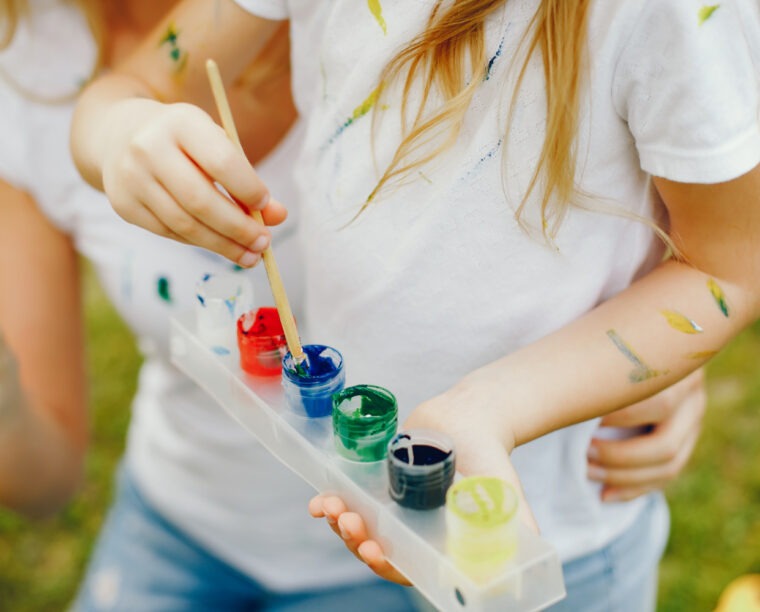
A child might express anger through strong scribbles on paper, work through sadness by kneading clay, release tension by stamping their feet, or find comfort by wrapping themselves in a blanket. Sometimes anger softens or sadness eases simply because a caring adult sits quietly nearby.
The most important thing is not to rush the child into talking, but to help them feel that their emotions have a safe place to be expressed.
The language of emotions develops gradually
Children do not learn to talk about emotions in a single conversation. They learn through everyday experiences: when a tower of blocks collapses, when a friend refuses to share a toy, when they miss their mum, or when they feel excited about a new discovery.
When adults stay close, patiently name feelings, and help children find appropriate ways to express them, a sense of security and trust gradually develops within the child. They begin to understand that all feelings are acceptable and that anger, sadness, disappointment, or frustration can be expressed without hurting themselves or others.
This is how children gradually learn the language of emotions – not through a single perfect conversation, but through countless everyday moments in which they feel seen, understood, and accepted. Over time, these experiences become a source of inner security, helping them understand that even the most difficult feelings are manageable and can be expressed safely and respectfully.